Saturday, February 23, 2019

Tuesday, February 19, 2019

The Argonauts - Wanting it both ways

I'm reading Maggie Nelson's The Argonauts.

Here is a quote. More posts will likely come over time as I read more.

Page 28-29: Wanting it both ways

Eve Kosofsky Sedgwick wanted to make way for "queer" to hold all kinds of resistances and fracturings and mismatches that have little or nothing to do with sexual orientation. "Queer is a continuing moment, movement, motive -- recurrent, eddyin, troublant," she wrote. "Keenly, it is relational, and strange." She wanted the term to be a perpetual excitement, a kind of placeholder -- a nominative, like Argo, willing to designate molten or shifting parts, a means of asserting while also giving the slip. That is what reclaimed terms do -- they retain, they insist on retaining, a sense of the fugitive.

At the same time, Sedgwick argued that "given the historic and contemporary force of the prohibitions against every same-sex sexual expression, for anyone to disavow those meanings, or to displace them from the term [queer]'s definitional center, would be to dematerialize any possibility of queerness itself."

In other words, she wanted it both ways. There is so much to be learned from wanting it both ways.

Self-Portrait as a Drowned Man

This photograph sees to be everywhere these days. Everywhere in my world of books of photographs. It's a protest photo from 1840. A self-portrait. A narrative portrait. Annotated. Imaginary. Pissed off.
Hippolyte Bayard, Le Noyé
(Self-portrait as a drowned man), 1840
© SFP https://sfp.asso.fr/en/

What story is it telling?

From Aperture: Simon Baker - Performative Work

Perhaps the earliest of these [performative works] coincided with the 1839 advent of the medium: Hippolyte Bayard produced Le Noyé (Self-portrait as a drowned man) in October 1840. A direct positive print on paper (and therefore an easier and cheaper alternative to the metal daguerreotype), Bayard’s self-portrait is not only a technical masterpiece but a conceptual one. It shows the inventor of the process, slumped as though sleeping, naked from the waist up, like Jacques-Louis David’s 1793 painting of the assassinated Marat; Bayard’s strangely dark hands a testament to both chemistry and hard work, crossed in peaceful resignation on his lap. But it is the title that completes the work, referring the viewer (whomever Bayard imagined that might have been) to the hopeless plight of the sitter: Bayard claimed to have invented photography before Daguerre, who received all the credit for the invention. In the photograph, he appears rejected, ignored, sinking without a trace below the high watermark of Daguerre’s fame and fortune. Bayard’s silent protest is probably the earliest, and certainly the greatest, of the first real performances made purely for the camera, and existing only as a photographic print.

From The Nonist: The Narrative on the back of the photograph

On the back, written in third person, is Hippolyte’s suicide note in which states his grievance rather explicitly.

Quote: “The corpse which you see here is that of M. Bayard, inventor of the process that has just been shown to you. As far as I know this indefatigable experimenter has been occupied for about three years with his discovery. The Government, which has been only too generous to Monsieur Daguerre, has said it can do nothing for Monsieur Bayard, and the poor wretch has drowned himself. Oh the vagaries of human life…! He has been at the morgue for several days, and no-one has recognized or claimed him. Ladies and gentlemen, you’d better pass along for fear of offending your sense of smell, for as you can observe, the face and hands of the gentleman are beginning to decay.”

Monday, February 18, 2019

Talking with Tommy

It was a bright cold day. Like today but not as cold. I took the L to 18th Street and walked to Tommy's gallery, Gallery19.

I had brought a box of 5x7 prints, a sampling of images that speak to me. Some I took. Some I downloaded from the Internet. Some of mine were of people and places. Others were of artists' work in museums that spoke to me. I grouped them. Portraits. Abstracts. Selfies. Vertical. Horizontal. Mine. Others.

We talked our way through the pictures. The different papers. The different tonal qualities. The use of various techniques and no technique. Some intentional. Some captured quickly in a moment.
L Tracks at Adams and Wabash

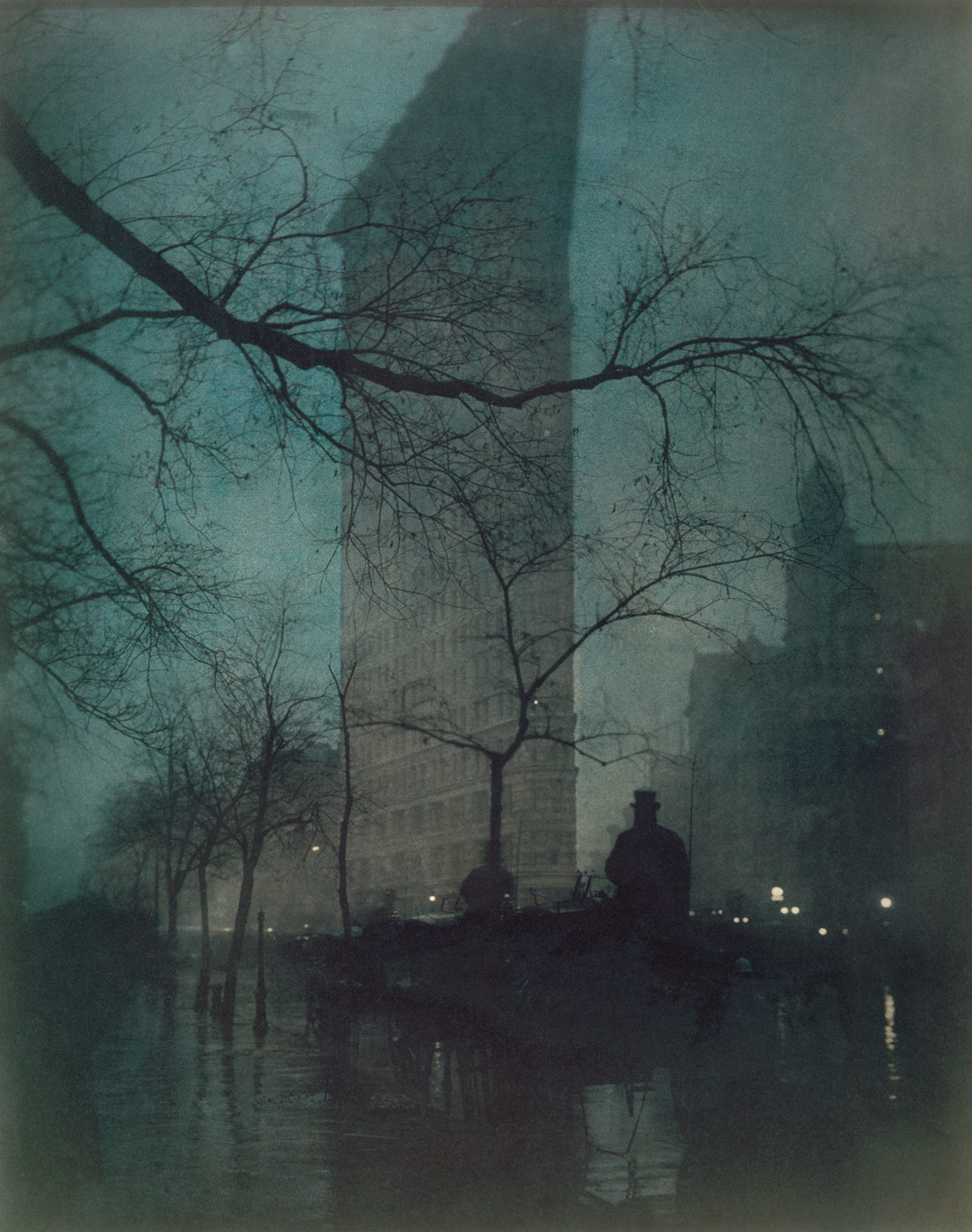
Tommy commented that there was an architectural quality to the images, that one could take portraits of buildings, that an architectural element could show up in pictures of people, like the work of Edward Steichen.
Edward J. Steichen: The Flatiron
(1904, printed 1909)

Looking for an image of Steichen's, I'm struck by the 110 years from when this image of the Flatiron Building was printed. How young the art of photography is. That Steichen lived until 1973, when I was 21. I might have met him in person. Our lives overlapped in time although not in the same place, at the same time. Might have but didn't, other than in his photographs and those of others inspired by him and his work.

Developing My Craft

Tommy had a few suggestions for taking my images further.
  1. Go out and play
  2. Think about the images
  3. Group them
  4. Read
  5. Repeat
Seem like the right things to be doing. Let the games begin!

Reading

Besides looking at images, the thing I like best is reading. Here are a couple of Tommy's suggestions. More about them at a later time.


Sunday, February 10, 2019

My Mindfulness Practice Today

100

My meditation practice today has been creating 100 squares of paper. They started out as a double-sided 8 1/2 by 11 sheet of paper. Each square was a strip of paper that had to be trimmed on all four sides, then folded twice. Slice. Turn. Slice. Turn. Slice. Turn. Slice. Slice. Slice. Stack the strips. Check on the geometry for folding. Trim the last edge. Fold into a square. One and another.

Strategic Health Network

I'm relaunching my consulting business this month at the HIMSS19 conference in Orlando and the NASL conference in DC. These will be opportunities to meet with old friends for our annual check-in, to explore what's happening in the world of Health IT, and to be surprised a few times. I'm looking for the sparks of excitement that will help me identify what's next.

To engage with attendees at these events, I designed a hybrid business card, brochure, resume and notepad. Something that would fit in the conference badge holder, that would stand out from all the business cards that everyone collects and then wonders "Who gave this to me?" "What did we talk about?" Not so big it was tossed in the heap of brochures and flyers only to be never looked at again.

Open Space

I especially wanted the back of the tri-fold to be mainly blank with just the Strategic Health Network url across the bottom. I plan to use this as "the back of an envelop" for a note or diagram.  The ideas that were the heart of a conversation.

It will be a good discipline for me to write or draw something, to do more than hand out contact info. The real value of a conference is the human connection, the random moments of shared thinking, the ideas that might still be valuable the next day.

Each of these small squares is filled with potential, an open field for dancing, This is one fill-in-the-blank exercise with only right answers. 👍

I'm looking forward to what appears!

Wednesday, January 23, 2019

The First Noble Truth - Life Is

Good Morning

Waking up, seeing what my phone is bringing me this morning. Continuing the exploration on my laptop. Photoessays at Lensculture, after a Buddhadharma study group last night.

Lensculture

https://www.lensculture.com/

Three articles that leave me raw:
Ana Vallejo: Entre Nubes
Rafael Soldi: Reflecting on Childhood
W. Scott Olsen: A Hard Beauty: A Review of Lynsey Addario’s “Of Love & War”

Beauty

A ... woman walks through a plume of smoke rising from a massive fire ...
as she searches for her husband © Lynsey Addario
The image is stark. A figure wrapped in fabric. Dark against a dark sky. Wind blowing. Smoke. Debris. A skeleton of a structure ahead. A slanted horizon. Off balance. Two feet on the ground.

Shapes. Light. Shadows. Before the words. Before the context. Lynsey Addario. A woman. Takes a photograph of another woman. A woman searching. Searching for her husband. 

A desolate space. In the frame. In the world. Then. 2003. There. A massive fire. Iraq. Chaos. Inside and outside the frame. 

Chaos. IRL. In Real Life. Death. Destruction. An order created by humans. Destroyed by humans. The same. Different. 

Personal. One person with another. Connections. Torn apart. The fabric of a life. The fabric of two lives. The fabric of a society. Shredded in a series of explosions. In the crossfire of tribes. A global fire sweeping through the life of one person. A life in flames. 

We see no flames. No tears. No wail of anguish. No wounds. No blood. 

The photograph is silent. Still. 

Yet it speaks loudly. Reaching out to me. I to it. Across time and space. 

Of all the images in this review, I chose this one to post. Abstract. One with the least detail. The least connection with a specific human. The caption is edited to remove the limited context that is supplied in the article. It doesn't matter exactly where this is, though of course it does. It doesn't matter exactly when it was, though of course it does. 

My gateway to the potent. Frame it. Dive in. 

The actions, the lives, this photograph speaks to were very particular, were very specific. The things not captured but imaginable. The sounds. The smells. The heat. The threat to the lives of the two people we know for sure were there. The woman in silhouette. The photographer behind the lens. The action surrounding them.

I scroll through the other images in the review. A flood of details. Some crisp in bright light. Some humor in the destruction. A destroyed plane looking like a cartoon bird. An Emergency Exit sign as though that opening would lead to a place of peace and safety. 

Moments of calm beauty. A person in the lush green of woods. Another at the prow of a boat on a still lake. 

Moments of ordinary intimacy. A mother combing her daughter's hair. Another mother feeding her daughter. A sister holding her sister. Children playing. Men carrying a fallen comrade. 

These too are fleeting. Yet captured in a photograph to come back to. To reflect on. 

Captured. Taken out of context. Brought into my life. On my screen. This morning. 


The Truth of Suffering

Last night. A study group. The Four Noble Truths. A meditative understanding of pain, which is life, and suffering, which is what we add. Of our experience. Living our lives. 

Lives with the chaos of ordinary living. Living with our mothers. Our mothers living with us. Living with our pets. Or the memories of pets who have died. Of relationships that have ended. Of the people we touch each day. 

Our desire to be of help. Teachers. Students. 

Healing. Not erasing the past. Not being numb to the pain. Finding a stronger, deeper humanity in how it has moved through us. Where it got stuck. Where we got stuck. Where I got stuck. 

Joy as well. Humor. Sparks of delight.

90 minutes of connection. Of exploration. 

[Join that group. It's on-line. Alternate Tuesday evenings. Come for one or more of the sessions.There is no charge. Hosted by the Chicago Shambhala Meditation Center.]


Tuesday, January 15, 2019

Abstract

Other than the Subject

Some of my images speak to me about form over content. What shifts the image from a representation to something else?


Some thoughts on what might lead to an abstract photograph

  • Out of context (close or far)
  • Out of focus
  • Out of exposure (bright or dark)
  • Out of contrast (low or high)
  • Out of stillness (camera or subject movement)
  • Out of saturation (desaturated/monochrome or supersaturated)
  • Pattern without form
  • Fragmented
  • Reflected
  • Layered
  • Composite