Friday, June 19, 2026

203 Park Avenue

… I arrived at "The House" - 203 Park Avenue, Arlington Heights, Massachusetts. It was my address for three of the next seven years. At that time I wasn't aware of the history of the other "workers" at Minor's various houses. The list included Walter Chappell, Michael Hoffman, John Upton, Paul Caponigro, Peter Bunnell, Douglas Prudden, David Plowden, and Bill Giles. Nor was I aware of the legion who had studied and worked with Minor, among them: Nathan Lyons, Jerry Uelsmann, A. A. Dutton, Carl Chiarenza, Ken Josephson.

Photo: Abe Frajndlich,
203 Park Ave, May 1975
The house was comfortless. It was designed that way. Tall, narrow, and white, it was set back from the street and hidden behind evergreens. Each room had a specific function. There was a viewing room off the front hall. It had a wall rack for photographs, suitable lighting, and almost nothing else but a couple of straight-backed chairs and a plant or two. In the room beyond it Minor sometimes received visitors. That room was more inviting. Some of his well-known photographs hung on the walls; there was a fireplace, more plants, and several cushioned chairs. The kitchen was at the back of the house. On the floor above, there was a study, a guest room, Minor's bedroom, a print room, and a bath. On the third floor, there were student quarters and the meditation room, and far below in the basement, the darkroom. Nowhere in the house was one invited to relax, to laugh, to gossip, or to waste time frivolously.

It was, however, an amazing place to live. In the library were all the copies of Aperture; monographs from a multitude of admirers and colleagues; many important photographic texts on the Zone System, photo-chemistry, and photo-history; as well as esoteric and mystical texts. There were also photographs from former and present students propped up on his desk and lying in stacks on the bookshelf. The phone rang constantly. Peter Bunnell was calling, or Ansel Adams, or Barbara Morgan. One never knew who was ringing the doorbell: a student with a portfolio, a curator from a prestigious museum, a critic or historian. We students knew we were at a generative nexus, and that was exciting. 

... There was a daily ritual in the house. At 6:30 in the morning the sound of Zen bells awakened us for meditation. 

... A painful awareness of Minor's death came six months after the fact, when I was working with Joe DeMaio in dismantling the darkroom. It was a maze of pipes and equipment, interlocking through three rooms. Each piece of copper tubing severed from the matrix and carried out bcame a graphic emblem of the house no longer pumping the vitality that it had for years. Those long lengths of copper resembled the tall gaunt figure he had become. When we shut off the water, it hit me that Minor was now really dead.

from Frajndlich, Abe - Lives I’ve Never Lived : A Portrait of Minor White (1983
[WorldCat]

Thursday, June 11, 2026

Sweet 'Enuff

Martin Wong, Sweet 'Enuff (1988) - right panel
at Wrightwood 659 / photo: Larry Wolf 2026

Saturday, June 6, 2026

Finding Myself (Again) in Tears

... the Balance and the Pattern which the true wizard knows and serves, and which keep him from using his spells unless true need demands ...

Ursula Le Guin - A Wizard of Earthsea - Warriors in the Mist (1968)
Illustration: Margaret Chodos-Irvine (1991)

He was born in a lonely village called Ten Alders high on the mountain at the head of the Northwest Vale.

... The name he bore as a child, Duny, was given to him by his mother, and that and his life was all she could give him, for she died before he was a year old. ... there was no one to bring the child up in tenderness. He grew wild, a thriving weed, a tall, quick boy, loud and proud and full of temper.

... A sister of his dead mother lived in the village. She had done what was needful for him as a baby, but she had business of her own 

... one day when the boy was seven years old, untaught and knowing nothing of the arts and powers that are in the world, he heard his aunt crying out words to a goat which had jumped up onto the thatch of a hut and would not come down: but it came jumping when she cried a certain rhyme to it. Next day herding the longhaired goats on the meadows of High Fall, Duny shouted to them the words he had heard, not knowing their use or meaning or what kind of words they were ... He yelled the rhyme aloud, and the goats came to him. ... He tried to get free of them and to run away. The goats ran with him keeping in a knot around him ... Villagers ran from their homes to swear at the goats and laugh at the boy. Among them came the boy's aunt, who did not laugh. She said a word to the goats, and the beasts began to bleat and browse and wander, freed from the spell.

... "Come with me"

... She took him into her hut... There his aunt sat crosslegged by the firepit, and looking sidelong at the boy through the tangles of her black hair she asked him what he said to the goats, and if he knew what the rhyme was. When she found that he knew nothing, and yet had spell bound the goats ... then she saw that he must have in him the making of power.

... As her sister's son he had been nothing to her, but now she looked at him with a new eye.

... she might teach him rhymes... such as... the name that calls a falcon down from the sky.

... "Aye, teach me that name!"

... "You will not ever tell that word to the other children..."

... "I promise."

... She smiled at his ready ignorance. "Well and good. But I will bind your promise. Your tongue will be stilled until I choose to unbind it. ... We must keep the secrets of our craft." ... She began to sing... and the singing went on and on until the boy did not know if he waked or slept. ... Then the witch spoke to Duny in a tongue he did not understand, and made him say with her certain rhymes and words until the enchantment came on him and held him still..

... "Speak!" she said to test the spell.

... The boy could not speak, but he laughed.

... Then his aunt was a little afraid of his strength, for this was as strong a spell as she knew how to weave... Yet even as the spell bound him, he had laughed. 

.. she taught him the true name of the falcon, to which the falcon must come

... as far as she was able, she taught him honest craft... 

...

... in the lust of conquest, the Kargs sailed next to Gont ... They went up the Vale wrecking and looting, slaughtering cattle and men ... Soon the people of Ten Alders saw smoke darken the eastern sky, and that night those who climbed the High Fall looked down on the Vale all hazed and red-streaked with fires where fields ready for harvest had ben set ablaze, and orchards burned, the fruit roasting on the blazing boughs, and barns and farmhouses smouldered in ruin.

... Duny ... had worked all night at the forge-bellows, pushing and pulling the two long sleeves of goathide that fed the fire with a blast of air. now his arms so ached and trembled from that work that he could not hold the spear he had chosen. He did not see how he could fight or be of any good to himself or the villagers. It rankled his heart that he should die, spitted on a Kargish lance, while still a boy: that he should go into the dark land without ever having know his own name, his true name as a man. He looked down at his thin arms, wet with cold fog-dew, and raged at his weakness, for he knew his strength. There was power in him, if he knew how to use it, and he sought among all the spells he knew for some device that might give him and his companions an advantage, or at least a chance. But need alone is not enough to set power free: there must be knowledge.

... The fog was thinning now under the heat of the sun ... as the mists moved and parted in great drifts and smoky wisps, the villagers saw a band of warriors coming up the mountain. They were armored ... there were about a hundred men, which is not many, but in the village were only eighteen men and boys.

... Now need called knowledge out: Duny, seeing the fog blow and thin across the path before the Kargs, saw a spell what might avail him. an old weatherworker of the Vale, seeking to win the boy as prentice, had taught him several charms. One of these tricks was called fogwearving, a binding-spell that gathers the mists together for a while in one place; with it one skilled in illusion can shape the mist into fair ghostly seemings, which last a little and fade away. The boy had no such skill, but his intent was different, and he had the strength to turn the spell to his own ends. Rapidly and aloud he named the places and the boundaries of the village, and then spoke the fogweaving charm, but in among its words he enlaced the words of a spell of concealment, and last he cried the word that set the magic going.

... Even as he did so his father coming up behind him struck him hard on the side of the head, knocking him right down. "Be still, fool! Keep your blattering mouth shut, and hide if you can't fight."

... Duny got to his feet. He could hear the Kargs now at the edge of the village, as near as the great yew-tree by the tanner's yard. their voices were clear, and the clink and creak of their harness and arms, but thy could not be seen. the fog had closed and thickened all of the village, greying the light, blurring the world till a man could hardly see his own hands before him.

... "I've hidden us all," Duny said, sullenly, for his head hurt from his father's blow, and the working of the doubled incantation had drained his strength. "I'll keep up this fog as long as I can. Get the others to lead them up to High Fall."

... The smith stared at his sone who stood wraithlike in that weird, dank mist. It took him a minute to see Duny's meaning, but when he did he ran at once, noiselessly knowing every fence and corner of the village, to find the others and tell them what to do.

... The tanner, whose house it was that burned, sent a couple of boys skipping right under the Kargs' noses, taunting and yelling and vanishing again like smoke into smoke. Meantime the older men, creeping behind fences and running from house to house, came close on the other side and sent a volley of arrows and spears at the warriors, who stood all in a bunch. One Karg fell writhing with a spear, still warm from its forging, right through his body. Others were arrow-bitten, and all enraged. They charge forward to hew down their puny attackers, but they found only the fog about them, full of voices.

... All the mist had come alive with these fleeing forms, dodging, flickering, fading on every side. one group of the Kargs chased the wraiths straight to the High Fall, the cliff's edge above the spring of Ar, and the shapes they pursued ran out into the air wnd there fanished in ta thinning of the mist, while the pursuers fell screaming through the fog and sudden sunlight a hundred feet sheer to the shallow pools among the rocks. and those that came behind and did not fall stood at the cliff's edge, listening.

... now dread come into the Kargs' hearts and they began to see one another, not the villagers, in the uncanny mist. They gathered on the hillside, and yet always there were wraiths and ghost-shapes among them, and other shapes that ran and stabbed from behind with spear or knife and vanished again. The Kargs began to run, all of them, downhill, stumbling, silent, until all at once they ran out from the grey blind mist and saw the river and the ravines below the village all bare and bright in morning sunlight. ... a wall of wavering, writhing grey lay blank across the path, hiding all that lay behind it. ... not one Karg looked back more than that once. all went down, in haste, away from the enchanted place.

... Farther down the Northward Vale those warriors got their fill of fighting. The towns of the East Forest, from Ovark to the coast, had gathered their men and sent them agains the invaders of Gont. Band after band they came down from the hills, and that day and the next the Kargs were harried back down to the beaches above East Port, where they found their ships burnt; so they fought with their backs to the sea until every man of them was killed, and the sands of Armouth were brown with blood until the tide came in.

... But on the that morning in Ten Alders village and up on the High Fall, the dank grey fog had clung a while, and then suddenly it blew and drifted and melted away. This man and that stood up in the windy brightness of the morning, and looked about him wondering.

... In the street, near the great yew, they found Duny the bronze-smith's son standing by himself, bearing no hurt, but speechless and stupid like one stunned. They were well aware of what he had done, and they led him into his father's house and went calling for the witch to come ... and heal the lad who had saved their lives and their property, all but four who were killed by the Kargs, and the one house that was burnt.

... No weapon-hurt had come to the boy, but he would not speak nor eat nor sleep; he seemed not to hear what was said to him, not to see those who came to see him. There was none in those parts wizard enough to cure what ailed him. His aunt said, "he has overspent his power," but she had no art to help him.

... While he lay thus dark and numb, the story of the lad who wove the fog and scared off Kargish swordsmen with a mess of shadows was told all down the Northward Vale, and in the East Forest, and high on the mountain and over the mountain even in the Great Port of Gont. So it happened that on the fifth day after the slaughter at Armouth a stranger came into Ten Alders village, a man neither young nor old, who came cloaked and barheaded, lightly carrying a great staff of oak that was as tall as himself. He did not come up the course of the Ar like most people, but down, out of the forests of the higher mountside. The village goodwives saw well that he was a wizard, and when he told them that he was a heal-all, they brought him straight to the smith's house. Sending away all but the boy's father and aunt the stranger stooped above the cot where Duny lay staring into the dark, and did no more than lay his hand on the boy's forehead and touch his lips once.

... the bronze-smith said to the stranger, "you are no common man."

... "nor will this boy be a common man," the other answered. "the tale of his deed with the fog has come to Re Albi, which is my home. I have come here to give him his name, if as they say he has not yet made his passage into manhood."

... "let him be named as soon as may be," said the mage, "for he needs hi name" ... I will come back here for the day you choose. If you see fit I will take him with me when I go thereafter. and if he prove apt I will keep him as prentice, or see to it that he is schooled as fits his gifts. for to keep dark the mind of the mage-born, that is a dangerous thing."

... On the day the boy was thirteen years old, a day in the early splendor of autumn while still the bright leves are on the trees, Ogion returned to the village ... and the ceremony of Passage was held. the witch took from the boy his name Duny, the name his mother had given him as a baby. nameless and naked he walked into the cold springs of the Ar where it rises among rocks under the high cliffs. As he entered the water clouds crossed the sun's face and great shadows slid and mingled over the water of the pool about him. he crossed to the far bank, shuddering with cold but walking slow and erect as he should through that icy, living water. As he came to the bank Ogion, waiting, reached out his hand and clasping the boy's arm wispered to him his true name: Ged.

... thus was he given his name by one very wise in the uses of power.

... he set off with his new master through the steep slanting forests of the mountain isle, through the leaves and shadows of bright autumn.

Ursula Le Guin - A Wizard of Earthsea - Chapter 1:Warriors in the Mist (1968)

Friday, May 22, 2026

Studio Day 78

Larry Wolf, Photographer at the Lincoln Memorial (1987/2026)
tiled image on newsprint 

Wednesday, May 20, 2026

Studio Day 77

Larry Wolf, At the Lincoln Memorial (1987/2026)

Monday, May 18, 2026

Longing to Make an Anti-Dystopia

What I am actually longing for

When I listen honestly, I am not longing to do nothing.


I am longing to make.


I want to make handmade paper.

I want to work with wet plate collodion.

I want to experiment without making every experiment prove its future usefulness.

I want to follow the material intelligence of the work.

I want to let my home become a studio again.

I want to cook, sleep, sort, mend, walk, read, and remember what kind of life allows art to arrive.

Hillary - The Slow Alchemist

Anti-Dystopia

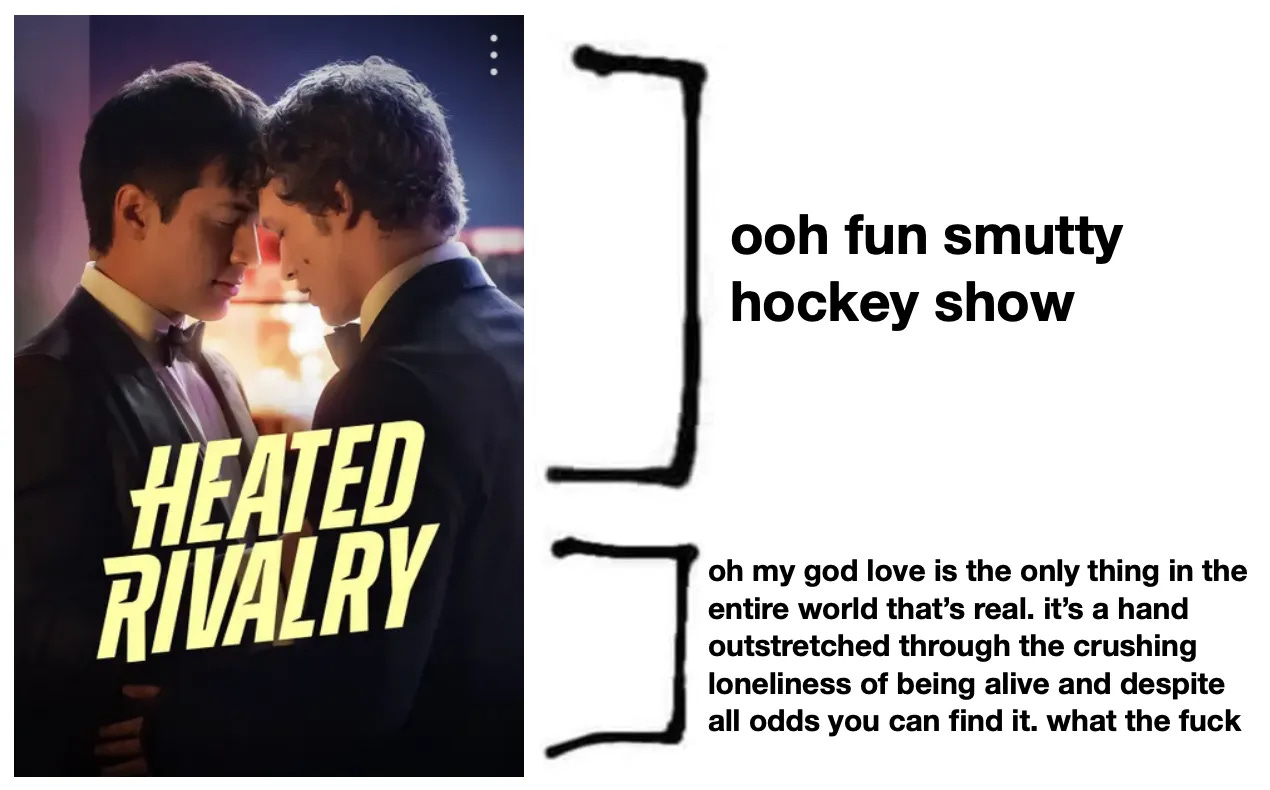
Jenka - Heated Rivalry and the Art of Anti-Dystopia

“We just want a future.” He speaks for all of us right now.  

Jenka - Heated Rivalry and the Art of Anti-Dystopia

Thursday, May 14, 2026

Studio Day 76

Larry Wolf, March on Washington 1987 - NAMES Project AIDS Memorial Quilt (1987/2026)

Sunday, May 10, 2026

Brian's Poems

Brian Hitselberger, Day Light / And Then / Night Fall (2026)
Photo: Larry Wolf (2026)

Saturday, May 9, 2026

Along 65N

Larry Wolf, Along 65N (2026)

Friday, May 8, 2026

Studio Day 75 - Call for Artists

6311arts Call for Artists - screenshot

This work is from my archive, from the 1987 March on Washington for Lesbian and Gay Rights. It was the first time the NAMES Project AIDS Memorial Quilt was displayed in DC. I was there with my then partner, several friends, and thousands and thousands of others. We had traveled from Vermont to Washington for the weekend - community, joy, rage - and tears.. so many tears, and laughter, and the deep awe of our presence taking over the Capital that weekend. 

This is a large print made by tiling sheets of paper. It will be taped directly to a wall along the top edge of each sheet. It's still very much a work in progress, though this current iteration feels good. The attached image is a prototype printed on regular paper. The exhibition print will be on vellum.

I'm also working a single legal-size sheet about the work which folds into a fortune teller, an artist statement and a momento to take away.

The work as displayed for the exhibition is priced at $750. ... I might also sell it as a limited digital edition with the right to print and install, say for $200. I'm open to discussion on pricing and the digital option.

Thanks for your consideration,
Larry

Larry Wolf, Celebration of Life on the National Mall (1987/2026)
printed on a grid of pages
56" x 73.5" (each tile is 8" x 10.5")

Wednesday, May 6, 2026

Studio Day 74

Larry Wolf, Lincoln Memorial Group Photo Shuffled (1987/2026)

Larry Wolf, Lincoln Memorial Group Photo Reverse Tracing (1987/2026)

Larry Wolf, Lincoln Memorial Group Photo Tracing (1987/2026)

Larry Wolf, Lincoln Memorial Group Photo Drawing (1987/2026)

Larry Wolf, Lincoln Memorial Massed Areas (1987/2026)

Sunday, May 3, 2026

Saturday, May 2, 2026

Studio Day 72 - Wrightwood

Martin Wong
Photo: Larry Wolf (2026)

Martin Wong
Photo: Larry Wolf (2026)

Martin Wong: Chinatown USA at Wrightwood 659

Friday, May 1, 2026

Studio Day 71

Larry Wolf, Printing on Vellum (2026)

Thursday, April 30, 2026

Studio Day 70

Larry Wolf, Commentary on Learning to See by Keith Sawyer (2026)

This is personal. As someone who had a flash of insight into how software works, and how when I was 16, I shifted my thinking to do it, I deeply believe that a mental reorientation is required to do software, data analytics or any "tech" or "hard science" well. It was my professional life. 

I've watched people work in software development and database groups for years and always be struggling. Their code worked but never very well and they were often stressed out. I've seen others write code as a kind of poetry, a structure that flows from them. The same with people who get databases and how to design them, how to extract information and meaning from all those 0's and 1's. I've seen it with friends who are mathematicians and physicists. 

These technical areas are design spaces, like the art spaces that Keith Sawyer writes about. They are disciplines that train the mind and change how our minds work.

There is something special to art in how the process of making becomes the path to knowing. It's not unique to art, it could apply to communicating with someone, of navigating through moments of confusion, when what one person says lands differently for the other, the "failure" to communicate could become an entry way to a deeper understanding of difference and connection, or it could become part of a larger disconnect. 

I'm reading Sawyer's Learning to See to further make that shift in my art making. 

[see also Keith Sawyer's substack. Lots of good stuff.]

Wednesday, April 29, 2026

Studio Day 69

Larry Wolf, Two Moments of Community
March on Washington 1987 (2026)


Tuesday, April 28, 2026

matt__runs

https://www.instagram.com/matt__runs/

I knew watching @heatedrivalrytv was risky. I didn’t expect it to crack me wide open. Some stories don’t feel like fiction. They feel like memories, carried deep in your soul.

Thursday, April 23, 2026

Studio Day 68

Larry Wolf, My Driver to the Airport (1998)

Wednesday, April 22, 2026

Studio Day 67

with my photo (1987/2026)
photo: Karen Dana Cohen (2026)

AIDS Memorial Quilt

Saturday, April 18, 2026

Colossus


Martin Wong
Wrightwood 659 - Martin Wong: Chinatown USA
photo: Larry Wolf (2026)

Larry Wolf, Torch and Crown (1998/2026)

Emma Lazarus, The New Colossus (1903)

Friday, April 17, 2026

Studio Day 66

Larry Wolf, April Fidget (2026)

Larry Wolf, April Fidget (2026)

Larry Wolf, April Fidget (2026)

Larry Wolf, April Fidget (2026)

Reference Images

Larry Wolf, AIDS Memorial Quilt - March on Washington 1987 (1987/2026)

Marsden Hartley, Garmisch-Partenkirchen (1933)
Milwaukee Art Museum

Max Beckmann, Wally Barker (1948)
Milwaukee Museum of Art

Wednesday, April 15, 2026

Studio Day 65

Larry Wolf, March on Washington for Lesbian and Gay Rights (1987)

Monday, April 13, 2026

Studio Day 64

Gertrude Abercrombie, brooch 
Milwaukee Art Museum
photo: Larry Wolf (2026)

Marsden Hartley, Garmisch-Partenkirchen (1933)
Milwaukee Art Museum

photo: Larry Wolf (2026)


“I think painting for him was a struggle. I think he was always struggling with those basic problems of being alive. ... 

"Everything is a potential existential crisis.  For an artist, you want potential. You want there to be conflict. Conflict creates friction. Friction create heat. When there's heat, there's potential for combustion, explosion, new knowledge. ...

"He was never satisfied with his work. At the same time, he was completely convinced of his own genius. That's enough to keep a person going. Why should you quit, if you're a genius? ...

"Hartley's most homoerotic work.. a totemic object.. it's all about the torso.. brute force.. like a tree trunk of a human being right in front of him. These men are elemental forms. It's not about the sweetness and tenderness of familial bonds between two men, it's barely homosexual. ...

"'I want this mountain. I need it. I have to touch it. I have to have it.' And the mountain rejects the artist. 'I have been here before you. You cannot possibly possess me.' Nevertheless, he's there trying. Grappling with it. Struggling with the thing he would like to possess. He gets the next best thing which is to possess an elemental symbol or idea of it. He does that with paint. ...

"I'm always excited to see a Marsden Hartley painting in the flesh, in person, in close contact with it. I'm excited. What I've learned to look for is there are big clumsy brush marks, clunky composition, it's thick. He's not trying to finesse reality, he's trying to beat reality out of the thing he's looking at."

Sam McKinniss, painter (b. 1985) 

Thursday, April 9, 2026

Tuesday, April 7, 2026

Studio Day 62 - over the years they had come to map all the places they could be together

Advance Reader Copy of Douglas Stuart, John of John
photo: Larry Wolf (2026)

"There had been a time in their late twenties when it seemed John could no longer pretend. He would come to Innes, his eyes rubbed pink with guilt and exhaustion. ... In those days, John snuck away more frequently and it was a feast for Innes. They led the dogs on long unnecessary meanders, until they found a hollow in the hillside somewhere dry, somewhere away from the eyes of their neighbours. The land was so bare it was a hard thing to find, but over the years they had come to map all the places they could be together and they came to know them by the flowers that grew nearby, or by the shape of the rocks that hung overhead. 

...

"He would ... ask John to spend a sunny afternoon curled up with him, the curtains drawn tight against the world... He had magazines about the gay community and he would read articles about the need to abolish Section 28, about the director who tended a garden next to a nuclear reactor. He would declare that what they were was 'gay'. And John would bear it silently. And he would hate it."

[Douglas Stuart, John of John, pages 169 & 222] 

Section 28

the director who tended a garden next to a nuclear reactor  / Derek Jarman

Saturday, April 4, 2026

Studio Day 61

Larry Wolf, Spring (2026)

Paul Thek, Meat Cable (1969)
Art Institute of Chicago
photo: Larry Wolf (2026)

Thursday, April 2, 2026

Studio Day 59

Four Generations in Brooklyn - Family Sedar 1957

Wednesday, April 1, 2026

Studio Day 58

Larry Wolf, Worktable (2026)
transfer drawings from used risograph stencils

Larry Wolf, untitled (2026)

Larry Wolf, untitled (2026)

Larry Wolf, untitled (2026)

Larry Wolf, untitled (2026)

Larry Wolf, untitled (2026)

Larry Wolf, untitled (2026)

Larry Wolf, untitled (2026)