Wednesday, May 20, 2020

Looking Inward Self Portrait Class - 19 May 2020

Chest and Belly

 
Soft pink flesh
Hairy plump scarred

Reveal
Grab

Aging male
Any old one
This old one

Alive 

Images

Larry Wolf, Chest and Belly w2p1 (2020)
Larry Wolf, Chest and Belly w2p2

Larry Wolf, Chest and Belly w2p3 (2020)
Larry Wolf, Chest and Belly w2p4 (2020)

Larry Wolf, Chest and Belly w2p5 (2020)
Larry Wolf, Chest and Belly w2p6 (2020)

Larry Wolf, Chest and Belly w2p7 (2020)
Larry Wolf, Chest and Belly w2p8 (2020)

Larry Wolf, Chest and Belly w2p9 (2020)

Larry Wolf, Chest and Belly w2p10 (2020)


Added Later

Larry Wolf, Chest and Belly addendum (2020)


Larry Wolf, Chest and Belly addendum (2020


References - Hands on Flesh

The work of two artists were bouncing around in my mind as I was working on the images: John Coplans and Gian Lorenzo Bernini.

John Coplans is famous for his portraits of his aging body, and the Bernini, this sculpture from the 1600s , is famous for the hand print, the imprint of the fingers in the flesh, which is in marble, quite an artistic accomplishment. The title of the Bernini is “rape”. It's a violent moment, cloaked in mythology, wrapped in beauty and polish. Coplans is that way too, very stylized, but making you see his aging body.  

John Coplans (1920-2003)

John Coplans, Self Portrait (Hands Spread on Knees) (1985)
Photo at tate.photo.uk

Coplans About the Photographs
I try to regard the body and mind as inseparable, a single field of human experience that encompasses the perceptual, the intellectual, and the pains and pleasures of memory. 

Gian Lorenzo Bernini (1598-1680)

Gian Lorenzo Bernini, The Rape of Proserpina (1622)
(photo credit: Joaquim Alves Gaspar (2015))

The Class - May 12, 2020 through June 9, 2020

Lillstreet Art Center - Photography Department - Online Looking Inward: Self Portraiture
Instructor Shterna Goldbloom


Monday, May 11, 2020

Advisors


Image with totems: a wizard with an owl, a child's doll, Bert and Ernie from Sesame Stret, Tibetan Buddhist rupas of Mipham and Ekajati, a child monk trumpeter, a modern Buddha, a 3-D printed astronaut, a rabbi, Athena, a jseter
Larry Wolf, Advisors (2020)

Sunday, May 10, 2020

Necessary Being

Necessary Being 

Aspirationally raw
Defiantly queer
Vulnerably human
 
Playful dance
Pandemic uncertainty 
Economic collapse
 
Much too joyful
Unknowable
Inseparable
Interdependent
Fearless
Sacred
 
Time and space
Covered
Shielded
 
Ignite with hot light
Incense and incantations
Flickering shadows
Destabilizing light
 
Naked
Sacrifice
Shattered
Mourned
Tentative
Quivering

-- Larry Wolf, 10 May 2020

Saturday, May 9, 2020

Honoring the Difficult - Open once again to love, intimacy and trust

Alice Walker - The Same River Twice - Honoring the Difficult (1996)

On the level where I most like to live, the level of contemplation, I realize that during these ten years I have been involved in a series of spiritual tests: a test of my love of and loyalty to my  mother, as I witnessed her decline over so many soul-whipped years, and worried constantly about my ability to protect her and provide for her needs, even as I felt myself to be in mortal danger. A test of my loyalty to myself, in my relationship with a partner, as I wrestled my way to the limits of my capacity for understanding, forgiveness and acceptance. A test of my belief in the creative integrity of others, during my involvement with the collective creating our film. A test of my faith in Nature and my love of the earth, which was, I now understand, what my illness was about.

Just as Muslims, Jews and Christians have crises of faith, when their God seems to have hurt them or abandoned them or never seems to be near, Pagans (people whose primary spiritual relationship is with Nature and the earth; people who have traditionally been oppressed or destroyed by patriarchal religions) have crises, too. This became obvious to me only this summer, when, after an absence of many years, I began seriously to garden again. Kneeling on the earth as I planted each small seed or set out each tiny plant, I was shocked to realize how many years had passed since I had done this. "This" being the prayer involved in planting that, I am convinced, was one of the first acts of supplication, of worship, in the world. When I asked myself why this absence from "service," from worship, the answer was: fear. Fear of tick bite, fear of disease, fear of debilitation. Fear. The benign Goddess/God I had assumed the earth to be had turned on me. My faith was battered by that betrayal. And yet, as with a lover, what can one really absolutely trust? Only that she or he will be themselves. And that, I see, is how I must love the earth and Nature and the Universe, my own Trinity. Trusting only that it will be however it is, and accepting that some parts of it may hurt. And so, with socks pulled high and sleeves pulled low to protect myself from tick bite and disease, I am back into the relationship with Nature that sustains my happiness and my faith. Back as well into sharing my work collectively with others. Open once again to love, intimacy and trust.
[pages 42-43]

Saturday, April 25, 2020

David Wojnarowicz - Flaming

Solidarity 2020 Poster


Poster with self portrait of David Wojnarowicz with flames along his body
David Wojnarowicz, Self Portrait (1983/84)

David Wojnarowicz with Tom Warren
Self-Portrait of David Wojnarowicz
1983/84

Between Bridges - Wolfgang Tillman

2020Solidarity is a Between Bridges project aimed at helping cultural and music venues, community projects, independent spaces and publications that are existentially threatened by the current crisis.


Thursday, April 16, 2020

Queering the Image - Pink Triangle Stamp

Self-Labeling with a Pink Triangle

“Stop the Brown Danger! 
Gays and Lesbians 
against Nazis!”
The Pink Triangle, a Nazi Holocaust marker for homosexuals, was reclaimed by activists in the 1970s and has become a way to self-identify as queer without tipping off the larger public. Even after the visibility of ACT UP, it is largely a secret code.

The Pink Triangle has become a way to connect with others. Some personal examples:

One day in the 1980s, I stopped on I-89 in Vermont to help a stranded motorist because they had a Pink Triangle bumper sticker.

At a meditation retreat in 1996, I wore a Pink Triangle enamel pin during registration. By the time I was through that process, half a dozen LBGT people at the retreat had gathered around me and we became instant friends.

When my husband and I first met, we both had Pink Triangle pins.

This dance of stepping up and stepping back, of passing and hiding, of public and private, is an active question in my life. What is it be be queer today?

As one way to explore that, I modified some self portraits using a pink triangle as a "stamp", trying various ways to incorporate it as a visual element. The dates on these images are that of the original and the 2020 update.

Larry Wolf, Pink Triangle Series (1952/2020)

Larry Wolf, Pink Triangle Series (1965/2020)

Larry Wolf, Pink Triangle Series (1975/2020)

Larry Wolf, Pink Triangle Series (1975/2020)


Larry Wolf, Pink Triangle Series (1978/2020)

Larry Wolf, Pink Triangle Series (1978/2020)

Larry Wolf, Pink Triangle Series (1978/2020)

Larry Wolf, Pink Triangle Series (1979/2020)

Larry Wolf, Pink Triangle Series (1979/2020)

Larry Wolf, Pink Triangle Series (1980/2020)

Larry Wolf, Pink Triangle Series (1998/2020)

Larry Wolf, Pink Triangle Series (1998/2020)


Larry Wolf, Pink Triangle Series (2000/2020)


Larry Wolf, Pink Triangle Series (2019/2020)


Larry Wolf, Pink Triangle Series (2020)


Larry Wolf, Pink Triangle Series (2020)


Larry Wolf, Pink Triangle Series (2020)


Sunday, April 12, 2020

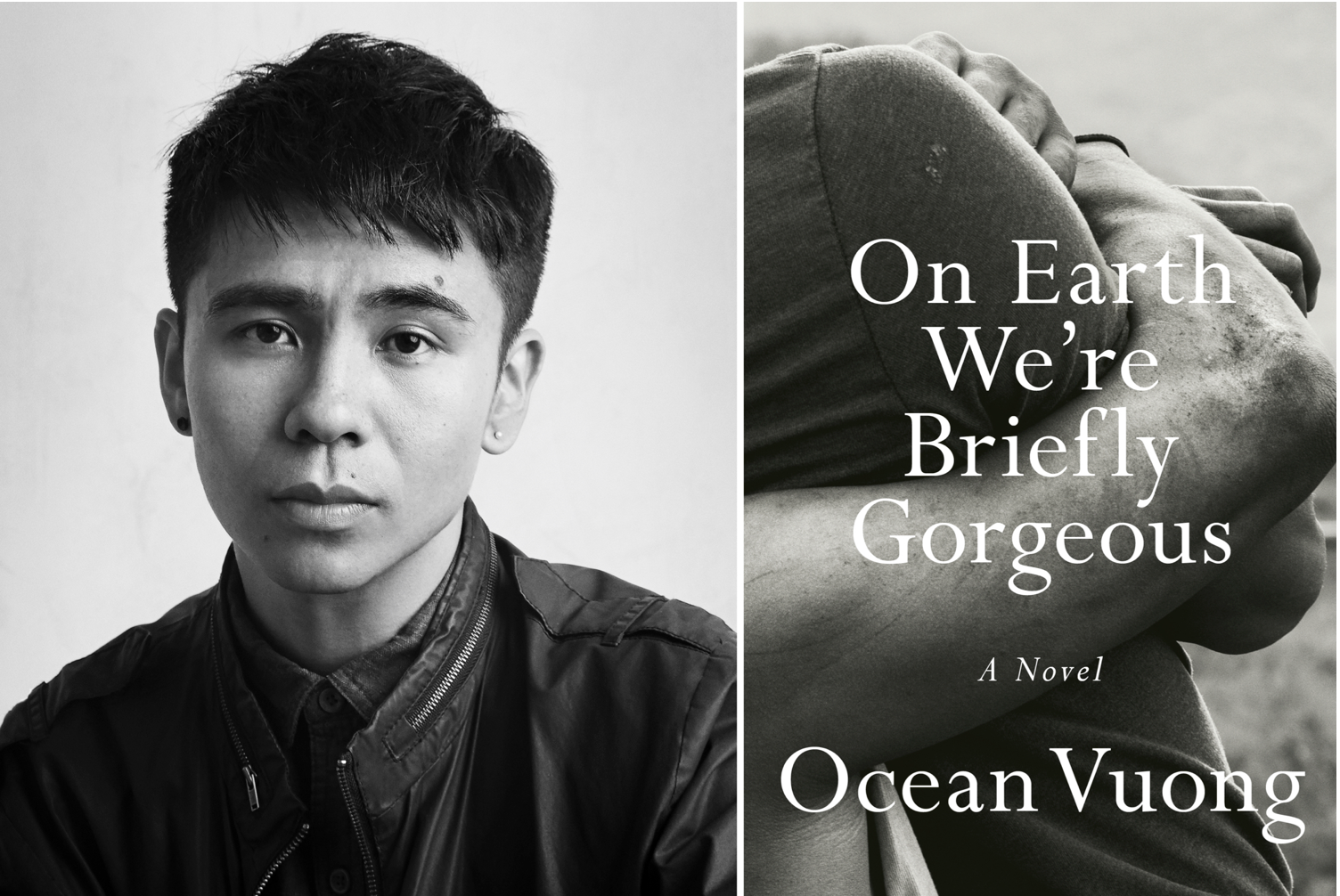
Ocean Vuong - Paris Review - 2019

A praxis toward reckoning

Paris Review (Author Photo: Tom Hines)

Two articles with/by Ocean Vuong in the Paris Review last year. Read them this morning. Thinking about these topics in my own life.

Survival as a Creative Force: An Interview with Ocean Vuong 

By Spencer Quong
Paris Review June 5, 2019

INTERVIEWER

Little Dog says, “I am writing you from inside a body that used to be yours. Which is to say, I am writing as a son.” There’s both intimacy and distance here: “used to be.” I imagine it’s not always clear how exactly our family’s voices arrive—or fail to arrive—in our work. How have you balanced your family’s voices with your own?

OCEAN VUONG

I wanted the book to be founded in truth but realized by the imagination. I wanted to begin as a historian and end as an artist. And I needed the novel to be a praxis toward that reckoning.

This book is as much a coming-of-age story as it is a coming-of-art. I would say that I begin with the voices of those I care for, family or otherwise, and follow them until they drop off, until I have to create them in order to hear them. My writing is an echo. In this way, On Earth is not so much a novel, but the ghost of a novel. That’s the hope anyway.

...

The gaze, human or animal, is a powerful thing. When we look at something, we decide to fill our entire existence, however briefly, with that very thing. To fill your whole world with a person, if only for a few seconds, is a potent act. And it can be a dangerous one. Sometimes we are not seen enough, and other times we are seen too thoroughly, we can be exposed, seen through, even devoured. Hunters examine their prey obsessively in order to kill it. The line between desire and elimination, to me, can be so small. But that is who we are. There must be some beauty—and if not beauty, meaning—in that brutal power. I am still trying, and mostly failing, to find it.

...

One question this novel hovers over is how do people who hurt each other find ways to protect themselves while attempting to love and, ultimately, to heal? I think Little Dog learns that to experiment is to innovate—and to innovate is to live in hope. Innovation is the first casualty of cynicism. The characters in this novel test each other because they possess an optimism that outlasts their hurt. And I adore them for that.

...

“I thought sex was to breach new ground, despite terror, that as long as the world did not see us, its rules did not apply. But I was wrong. The rules, they were already inside us.”

I wanted to arrive at queer joy—but discovered that I wanted to do so without forsaking the very real and perennial presence of danger that queer bodies face simply by existing. There is a call, rightfully, for literature to make more room for queer joy, or perhaps even more radically, queer okayness. But I did not want to answer that call by creating a false utopia—because safety is still rare and foreign to the experiences of the queer folks I love, who are also often poor and underserved. I didn’t want to pretend to be happy just because straight people were tired or bored of our struggle.

The novel insists that there is power, and with it, agency, in survival—which includes the interracial tensions you speak of—because trauma is still an integral reality for queer folks. But these bodies do know joy, and they know it by acknowledging and honoring the tribulations they outlived. We often think of survival as something that merely happens to us, that we are perhaps lucky to have. But I like to think of survival as a result of active self-knowledge, and even more so, a creative force.

...

“We were exchanging truths, which is to say, we were cutting one another.”

...

INTERVIEWER

I remember listening to you read at the University of Massachusetts a number of years ago when Night Sky was released. I remember the quiet of that room, the ways your pauses swept over the audience. I’m curious about how it feels to you when you read your work aloud.

VUONG

You were there! That makes me retroactively happy. I was so nervous that night, but someone had the merciful idea to turn off the lights. And I grew braver in the dark, which became somehow more intimate, less lonely. I’m not really a social person. I’m naturally shy and avoid parties when I can. ... So I never dreamed of being a reader in front of an audience. But when I started to do it, I realized I was participating in an ancient oral tradition, one that made not only Vietnamese literature possible, but solidified the practice of storytelling in our species. I started to see the air as a second page. The book, any book, as you encounter it between two covers, is essentially a fossil.

...

I’m not interested in possession. I want to be freer than that. Maybe I’m being naive, but I understand genres to be as fluid as genders. Our lives are full of restrictions—jobs, bills, time, gravity, all of this impinging on us—but to write is to gift yourself the freedom of choice and possibility. That feels truly precious to me.

If we must think in metaphoric structures, then I would rather say the novel is a town square—a space where people converge, where they’ll see these characters, see me, see each other, then go on home, perfect just as they are.


Reimagining Masculinity 

By Ocean Vuong
Paris Review June 10, 2019


No homo.

You’re really good at hiding.

Years later, in another life, before giving a reading, the organizer asked me for my preferred pronouns. I never knew I had a choice.

Can the walls of masculinity, set up so long ago through decrees of death and conquest, be breached, broken, recast—even healed? I am, in other words, invested in troubling he-ness. I want to complicate, expand, and change it by being inside it.

No homo, K reminds me, as he bites off the medical tape, rubs the length of my swollen ankle. He slides my white Vans back on—but not before carefully loosening the shoelaces, making room for my new damage. No homo, he had said. But all I heard, all I still hear, is No human. How can we not ask masculinity to change when, within it, we have become so wounded?

“You’ll be fine,” he says—with a tenderness so rare it felt stolen from a place far inside him. I reach for his hand.

I make it so dark we could be anything, even more than what we were born into. 

We could be human.