Monday, October 7, 2019

Botanic Garden Reflections


Class Assignment: A Stroll with Theophrastus

Walking, the class is tasked with taking a picture and in sitting down at the site where the picture was taken, and having both the photograph and the natural subject as reference material are asked with pencil and paper to describe in the most specific and eloquent way which essential quality the photograph is meant to capture and express.

The class will take turns reading their descriptions aloud, and will engage in conversation about the essential quality of each photograph's subject, as claimed by its photographer.

The two "pictures" will be considered a diptych, and may be complicated further if a drawing is included.

Images and Writing

Scanning, looking and questioning: What is it that caught my attention?

Stopping to make a photograph, one leads to another. Stepping away. Sitting down to write. Comparing what’s on the camera screen with what’s in front of me and what I imagined. The whole process one of slowing down. Looking broadly. Looking closely. Seeing how the different moments come together in the image. Or fail to come together.

What resonance is there beyond a well composed, well exposed image?

#1: Head of Grass

A mound of grass - a head of hair wanting to be brushed - something amusing in a plant looking human, above bright flowers and the flow of water
Larry Wolf, Head of Grass (2019)


Reflection

Of the five photos made of this mound of grass, the last, from a distance, looking back, speaks to me the most.

What was intended as a context shot seems to tell the whole story and is also visually the strongest. It shows the created symmetry of the formal gardens. These are not wild grasses, wild flowers or free flowing water. Contained. Ordered. Manicured. A garden is a created thing. It is also an exercise in giving up control - the growth of the plants, the decay of the structures, the unpredictable weather.

Making an image is also working with the materials at hand, the objects, the light, movement, stillness, the technical capabilities of the technology and the experience of the photographer. The mound of grass stands proudly at the center of the garden.

#2: Standing on Water

I was drawn to the leafy water plant among the waterlilies - got up close to what I imagined.
Larry Wolf, Standing on Water (2019)


Reflection

The image shows the structure and texture of the plant above the water. The waterlilies and clump of plants on the edge provide context. Shadowlike, the dark reflections further enhance the shape of the plants. There is mystery here. Are the dark leaves reflections? Shadows? Another plant?

#3: Red Rose

“Single” red rose floating in a sea of green, through a break in the trees. Can I capture the sense of surprise?
Larry Wolf, Red Rose (2019)


Reflection

In the image, other red roses also float above the foliage. None of the roses are in focus. Perhaps it works better this way, a smear of red, multiple dots of red rose. There are little red berries in the trees. More here than originally seen.

#4: Arches into Garden

Ceramic tile half pipes set in a brick wall, allowing a view into the other side. People walk by. Wait. There will be more.
Larry Wolf, Arches into Garden (2019)


Reflection

The brightness and the darkness across the frame and coming through from the garden. The arches of ceramic creating frames within the frame. The visual field cut into repeating, non-rectangular, pieces.

The ceramic window creates a substantial barrier to the garden on the other side. Sound and light may travel through but I cannot. I’m blocked off. I can see small parts of the garden through the multiple tunnels of view through the tile. They guide my eye and keep me at a distance. A very solid fence that I can see through but cannot reach through, cannot touch what lies on the other side.

#5: Cabbages!

A sea of cabbages. Ornamental. Edible.
Larry Wolf, Cabbages (2019)


Reflection

This is the fourth shot of cabbages in this garden. The leaves curling around the center of the plant. The whole bed bursting with them. The layers of garden up and down the frame: sidewalk, cabbages, brick wall, hedge, trees.

More cultivation and wildness. The abundance of the cabbages. The hard surface of the walkway and the wall. The multiple horizontal stripes create a layering and are also a flat surface. There is abundance and it is locked in the aesthetics of the garden. Visual nourishment, not bodily sustenance.

#6: Square Tree

A giant hedgerow of trees. What’s the right angle to show them?
Larry Wolf, Square Tree (2019)


Reflection

A pair. Isolated. Yet caught in the visual chatter of the other trees. The flat white sky is a perfect surface to backlight the texture of the tree, the artificial shape it has been pruned to.

3pm: Chimes

Heard and not seen. No photograph.

Reflection

Time is passing while I wander making photographs. People swirl about in constellations, individuals orbiting around their groups’ moving centers of gravity. I have my own momentum through the gardens, stopping, seeing, exposing, reviewing, writing.

The chimes stop my activity for a moment. I shift into my body. Standing. Listening. Feeling the passing of time. Attentive and relaxed.

#7: Water

The surface of the water catches the light, shows cross-currents of motion, bright and dark spots dance across its surface.

Ripples and reflections in the water. Sacred island in the distance. How to get just the water? How to show this pond as vast?
Larry Wolf, Water 7a (2019)

Larry Wolf, Water 7b (2019)


Reflection

Which image to choose? Here is a pair with no land, no trees. Light and dark. Mystery and also simply water. Boundaryless. Fluid and static. A moment.

#8: Sunflower Bride

Flowers scattered across a lawn. Large sunflowers on short stalks… get up close… shoot low and up into the flowerhead. Fighting with framing and exposure and focus and wind.

Then, walking along the path in the distance, a pair of photographers, the groom, the bride. They appeared suddenly. The camera remained on the exposure for the closeup of the flower.
Larry Wolf, Sunflower 8a (2019)

Larry Wolf, Sunflower 8b (2019)

Larry Wolf, Sunflower 8c (2019)


Reflection

This feels like a sketch of what I wanted. The rough texture of the seeds. The jagged edges of the petals surrounding the seed head. The white, burnt out, sky. The finality of the season. A fierce ring of teeth surrounds the mouth filled with seeds, the fruit of the summer. The white petals bite into the seeds. Like bones bleached in the desert sun, a ring of death surrounds the future life.

The people walking behind the flower, overexposed, burnt out yet clearly visible. The wedding may represent a new beginning, yet they feel (to me) like a medieval theater troupe, moving through the landscape, bringing welcome distraction during the Black Plague. In 8b, the first man carries a black hood, the second man has his hands raised in prayer, or so I see it. In 8c, the groom, in black, is cut through, while the bride, in white, is a hole in the image, her hands holding a bouquet of flowers, an echo of the sunflower with its strong stem, her face and hair the only bit of human texture.

Overall

It is the beginning of autumn. The great wheel of the seasons is turning. The plants are still vigorous and, in their maturity, signaling they will soon perish, that winter is not far away.

These are formal images. Surfaces that are meant to hold the viewer’s attention with texture and light and shape.

Where is the photographer, in these images? Playful and serious. Seeking and discovering.

There is a joyful exploration at the beginning, the humor of grass that looks like hair, the pop of color with the rose, light and darkness in water, a sunflower at the end of the season, the wedding party caught as ghosts.

Footnote on Theophrastus

Theophrastus (c. 371 – c. 287 BC), a Greek native of Eresos in Lesbos, was the successor to Aristotle in the Peripatetic school. ... Theophrastus presided over the Peripatetic school for thirty-six years, during which time the school flourished greatly. He is often considered the father of botany for his works on plants.

Thursday, October 3, 2019

More Or Less Transparent

Looking from the W Hotel to the Treasury Building, Washington DC, September 25, 2019.

Here are 4 of the 18 images in the series.
Larry Wolf, More Or Less Transparent (2019)

Lillstreet Photobook Library
Five prototype booklets were created, one of which now resides at the Lillstreet Photobook Library.

Wednesday, September 4, 2019

September Morning Walk


 Larry Wolf, September Morning Walk (2019)
Larry Wolf, September Morning Walk (2019)

Larry Wolf, September Morning Walk (2019)

Larry Wolf, September Morning Walk (2019)

Larry Wolf, September Morning Walk (2019)

Larry Wolf, September Morning Walk (2019)

Larry Wolf, September Morning Walk (2019)


Tuesday, September 3, 2019

Camera in Hand... Walking

Larry Wolf,
Metra Union Pacific North (2018)

Most Weekdays 

I walk with my husband to the train he takes to work. We walk west, the morning sun behind us, for the eight or nine minutes to get to the station.

Larry Wolf, Three Routes Overlap in the City (2019)
I continue walking, typically one of three different routes: a one-block wide six-block east-west journey which may end at a coffee shop across the street from our home, a longer east-west journey with a one-block jog north at the west-most edge to a coffee shop, or a more square route north and east to a coffee shop and then south to home. The walking time varies between fifteen and forty minutes. A day begins.

Intentionally Aimless

The walks have no particular purpose other than to start the day together, to step outside, to wake up slowly, one step at a time, wishing Eric a good day, and by walking, in the neighborhood, whatever the weather is, as the seasons change, noticing the sky, the traffic, the buildings (and the activity of building), the people (and their dogs), the trees and other plants, sometimes in bloom or past bloom, a passing train, occasionally a rabbit, being with whatever is happening each day. Sometimes stopping at a coffee shop, as much about taking time to pause and consider the day ahead as to have another shot of caffeine. I've been doing this for the past six or seven years (yikes!).

I often stop and capture moments in pixels. They collect in the cloud. They rain down as texts or tweets or are posted to Instagram or to this blog.

Meditation

Walking can be a formal or informal meditation practice. How much am I conscious of the whole experience and its details? The feel of my feet as they touch the ground, one foot, the other foot, weight shifting, toes in shoes, legs in pants, limbs and joints in motion. The world going by. Breathing. Breathing and walking. Sensing. Awake and asleep. Embodied. Part of and not separate from the environment. Sometimes. It comes and goes.


A Companion

A camera has been my companion for years and years. Not just on my morning walk, but out and about generally, at work, at meals, at museums, all the parts of my life. In my twenties, I pretty much lived with a camera, sometimes shooting from the hip, often with more formality. Almost never any staging, almost always full frame.

There was a dual aesthetic of authenticity, that the image should be of my life, as it happened, a close-in documentary, and that what was on the film emulsion needed to be shown in full, the whole story without further reframing. This was also a commitment to a specific discipline of being with the camera, developing the reflexes to focus, frame and release the shutter quickly, more and more on instinct feed by the cycle of shooting and printing.

Larry Wolf,
Companion (2019)
People were the primary subjects, friends, family and co-workers as we went about our day, making a connection with them through the lens, through the images. Other times, I was more in my own bubble, turning a purely inner experience inside out, making something to share.

Seeking to reconnect with that, I dusted off an ten-year old digital camera and resumed having a camera with me. I've stuck with that old friend for this past year. One camera, one lens, a fixed focal length. Creating a consistency of what I'm using. Allowing a friendship to emerge.

Allowing. A Friendship. To Emerge. 

Allowing, not forcing something conceptual, getting out of my own way. Letting it develop over time. Feeling my way into knowing who I am as I hold the camera. Who the camera is, the life it holds in its body, in its technology, in its settings. , but having it develop from the inside. Feeling my way through the options of subject, shutter speed (freeze the motion or show it? move the camera or hold steady? how slow is slow enough? how fast is fast enough? run experiments and see results).

The friendship is as much about my relationship with myself as with the camera. Having the camera in my hand, I feel the lightness of it. Solid and present, balanced. My thumb rests in a slight curve in the corner, my fingers wrap around the edge, a gentle grip, a relaxed hold. Ready. I notice something, see it on the view screen, adjust the exposure, the angle, touch gently to focus, hold and reposition, wait for a moment, press through to the snap of the shutter. Physical and digital, optics and electronics and human together.

I pick up the camera, curious to what emerges.

Life Is Fragile and Resilient 

There is a tentativeness, a fragility, that wasn't there before. I'm not twenty-something, out to seduce the world. I'm not the same person who first used this camera ten years ago, enthusiastic for a new piece of gear, on vacation, exploring a new place. Almost seventy, life is pain and joy. Grand visions have crashed and burned. Persons, places and things which were safe refuge turned out to be merely illusions. Deeply disappointing. Certainly impermanent. Subject to change. Old relationships are revisited, touched fresh, reawakened. Some are found dry, brittle, sun-bleached; they fade away, are walked away from, are cut off.

Alive. Being alive is all of that. Change. Disappointment. Joy. Illusion. Vision. Order forming and dissolving. Routines established and dropped. Weight gained and lost and gained again. Births. Deaths. Deaths. Births.

Day to day, one breath at a time, getting to know the moment, to know me in this moment, to feel the current streams flowing through me, to find fresh sustenance.

Though not fully intuitive, I am getting better at knowing what this camera sees, better at simple post-processing, better at images that resonate although not always in ways I expect or understand. I don't have the full immersion of years ago, I don't do it all the time, but it's growing.

Transformative

Holding a camera in my hand transforms my seeing, shifts me into a visual mode. My thinking moves into my eyes, into the eye of the camera. The camera becomes a method for letting go of the usual mental chatter. A simple curiosity takes over. What is this? How does light bounce off its surface? What is in the shadows? What has caught my eye? How does it change as I keep looking? The questions are more attitude than words. Like the ringing of a gong or the lighting of incense, holding the camera invites the meditative mind into the foreground.

And then there is training: classes, critiques, readings; experimenting with points of view, use of reflection, of motion, of focus, of framing. Conscious choices, actions and what results; deepening my skill in the mechanics; opening me to see more, more layers, more whole. The craft and discipline further open the experience.

Revealing

Yesterday Miriam Hall talked about images she made in Barcelona in the days immediately following 9/11. The images were unlike anything she had taken before -- fragmented, disjointed, chaotic -- revealing her state of mind. Looking at the developed film was a surprise. She did not know her mind, did not know what she was making. Then she saw her mind in the prints. Ah yes, this is why I photograph.

A few weeks ago a friend mentioned how he was taken by individual letters, drawing each one, richly formed, as individuals, worthy of attention. It reminded me of Arthur Rimbaud's poem Vowels.

A Black, E white, I red, U green, O blue : vowels,
I shall tell, one day, of your mysterious origins
...


Larry Wolf,
Canopy (2019)

Aspiration

I'm looking for that direct link from mind to image/image to mind, short circuiting the inner narrator who is writing the story and shaping perception before anything is seen, as the shutter is released and an image is captured. Looking for surprises when reviewing the result, for moments where my mind gets out of its own way and sees, with the camera, directly, sees what is as it is. And to let go of the whole thing. May it be of benefit.

Thank You

A short note of thanks to Becky for hosting and teaching contemplative art, for Levi for his photographic walks and upcoming workshop, for the many people who have nurtured and challenged me over the years and especially my husband Eric who has been the homo fabula in my life for twenty years.

[Originally posted September 3, 2019. Revised September 5, 2019]


Friday, August 30, 2019

Tuesday, August 20, 2019

August Ravenwood Flowers

Larry Wolf, August Ravenswood Flower (2019-08-12)

Larry Wolf, Ravenswood Flower (2019-08-16)

Larry Wolf, Ravenswood Flower (2019-08-16)

Larry Wolf, Ravenswood Flower (2019-08-19)

Larry Wolf, Ravenswood Flower (2019-08-20)

Larry Wolf, Ravenswood Flower (2019-08-20)

Monday, August 19, 2019

MoCP Exhibit and Podcast - Focal Point: Dawoud Bey and Teju Cole & Go Down Moses

Images and words. Images assembled into groups. Words in conversation. Reflected and refracted.

Stitcher: Focal Point, Episode 3
Writing this began with a Focal Point podcast from Columbia College Chicago, a discussion with Dawoud Bey and Teju Cole, hosted by Kristin Taylor (quotes from which are below, in italics).

Bey and Cole have both recently created exhibits by selecting from the archives of a museum (Dawoud Bey, Art Institute of Chicago, This Land Is Your Land and Teju Cole, Museum of Contemporary Photography, Go Down Moses). Go Down Moses is still at the MoCP (July 18 through September 29, 2019).

What to select?

Museums are powerful cultural forces. They honor our collective past and shape our future. Their power has received heightened attention, from the membership of their Boards of Directors, to their curators, to the works in the collection (and sales from that archive to fund new acquisitions as part of reshaping the collection), to a broader invitation to open their doors to the people of their local communities (yes, institutions and geographies are intersectional). 

What to select is a core question of how we function as a society, the voices we bring into the conversation, and how we build from the diversity of our many cultures. We are the same humans with very different personal and communal histories, and with structural imbalances of power and wealth. 

What is in the archive?

How does the archive reflect the bias of the institution?

How are decisions made about what is art and what (and who) is worthy of our attention?

It is the challenge of our 21st Century lives. Where do we put our attention? What do we select from the endless options all around us? How does that selection process shape our future?

Personal and Specific

Where does my attention land? What am I drawn to, repulsed by or breeze by? This is a personal question, a personal experience. The answers are personal.

How do I, how does each of us, respond to a photograph, whether one we make or one we come across?

"Certain pictures that hit you right between the eyes"

"A photo I wish I had taken"

Bey and Cole express their own humility in making photographs, that a photographer might only make one picture which really touches us, perhaps the best make a dozen in their lifetime that hit that mark. A reminder for those of us who are working to photograph in ways that have a deep resonance for ourselves and others. Patience. Nurturing. Curiosity. Open to the magic.

Grace Note

Early in the podcast, they discuss the grace note of Go Down Moses, Roy DeCarava's Man in Window.
Roy DeCarava, Man in Window (1978)
As the study guide suggests, this image is worth spending time with, adjusting to the darkness, soaking in the patterns within patterns, feeling the presence of the man in the window gently lit from an unseen source (A television? What is he watching as we, by way of the photographer, watch him?).

Larry Wolf, MoCP Wall of Images
(2019)
The photo is on the back wall of the exhibit, on the third floor. The first time there, I missed the image entirely. The adjoining wall is a mass of images, all brightly lit against a white wall. I was saturated, unable to shift from the cacophony of the many images to the stillness of the one.

I'm glad I went back a second time and started at the end.
Larry Wolf, MoCP Last Image
(2019)

In a world that is full of bold colors, high contrast, brighter than bright attention grabbing moments, it is very refreshing to simply stop and look. To let the graphic elements float in front of me. To see the image as light and dark, loose and tight patterns, associated ideas and direct observation.

A few of the photographs in Go Down Moses are similarly mostly black. They seem to be punctuation points in the exhibit. Stopping my eye as I scan the wall. Causing me to pause and look closer, closer at that one image and more closely at the images they are grouped with.


Tenderness combined with strangeness 

Gordon Parks,
Young Boy Standing in in the doorway of his home
 on Seaton Road in the northwest section.
His leg was cut off by a streetcar
while he was playing in the street (1942)

"Tension in the interpretation of what you are seeing."


The photographer looking

"Locations retain the ghosts of things that happened there"

"Public, social and quietly intimate"

http://www.mocp.org/detail.php?t=objects&type=browse&f=maker&s=Bey%2C+Dawoud&record=53

How does one visualize the passing of time?

"How do you do the thing with a camera that photography is designed to not do?"

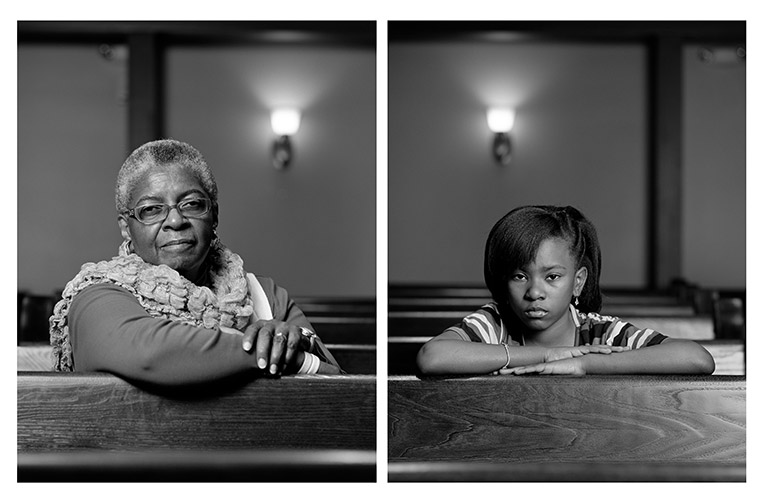
Dawoud Bey, Mary Parker and Caela Cowan (2012)
Dawoud Bey, Michael-Anthony Allen and George Washington (2012)

"It is designed to make a still image of a moment. How do you make something about an extended period of time?"

In these photographs Bey pairs two life-size portraits representing the victims of the 16th Street Baptist Church bombing and related violence in Birmingham that Sunday in 1963: one portrait of a young person the same age as one of the victims, and another of an adult 50 years older—the child's age had he or she survived. [Press release from the exhibit at the National Gallery of Art, September 12, 2018 through April 22, 2019]
This exhibit was also at the MoCP, April 11 through July 7, 2019.

Life at its best

"I know I'm at my truest and best self when everything is in conversation and I don't have to make declarations of any kind of purity."

"If I did believe in god, god would be against any kind of purity and isolation because we are all in this together."

Thank you 

Shawn Rowe suggested I listen to the podcast and also asked me about the Roy DeCarava grace note photo. Thank you Shawn (http://shawnrowephotography.com/) for bringing them to my attention.