Friday, January 15, 2021

Muddy Water Becomes Clear


Larry Wolf at Wisdom 2.0 (February 2017)

The glass of water in the photo has mud at the bottom which has settled over the course of a meditation retreat. The critical step is to stop stirring, allowing the dirt to naturally settle. So too with our minds.

I wrote about the retreat on my work blog back in February 2017. The need to combine stillness and action continues.

Thursday, December 17, 2020

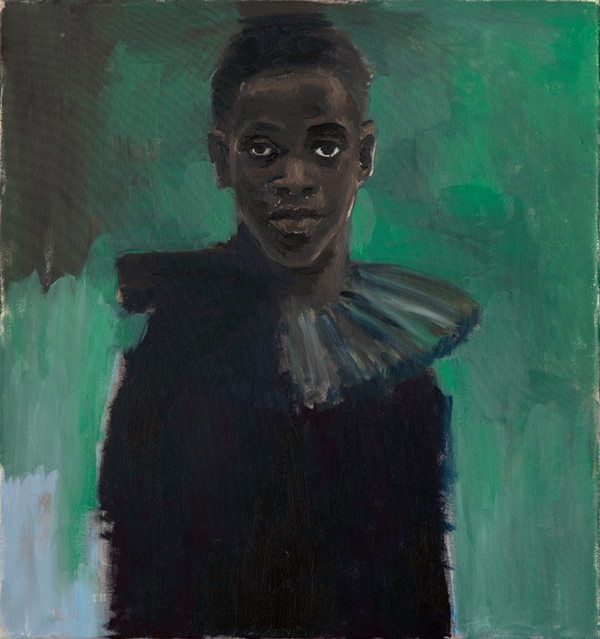
Lynette Yiadom-Boakye

 Fly in League with the Night at Tate Britain

Lynette Yiadom-Boakye
A Passion Like No Other (2012) 
Collection of Lonti Ebers  © Lynette Yiadom-Boakye

NY Times: Lynette Yiadom-Boakye's Subjects Are All in Her Head

“Going from the sense of trying to illustrate an idea, to allowing the paint to bring something to life, or thinking about painting as a language in itself — that was the major shift”

Tate: Exhibition Guide

"I learned how to paint from looking at painting and I continue to learn from looking at painting. In that sense, history serves as a resource. But the bigger draw for me is the power that painting can wield across time.

"I work from scrapbooks, I work from images I collect, I work from life a little bit, I seek out the imagery I need. I take photos. All of that is then composed on the canvas. [This lets me] really think through the painting, to allow these to be paintings in the most physical sense, and build a language that didn’t feel as if I was trying to take something out of life and translate it into painting, but that actually allowed the paint to do the talking."

https://www.tate.org.uk/whats-on/tate-britain/exhibition/lynette-yiadom-boakye/exhibition-guide


Tuesday, December 1, 2020

Further Readings on Homosexuals, Holocaust and History

Unknown Photographer,
Prisoners in the Concentration Camp at Sachsenhausen, Germany (1938), 
US National Archive of Foreign Records

My reading to further explore this photo from Sachsenhausen continues (see also this post from August 2020 with earlier books). 


Who are these people? 

What was their experience before and after this photograph was taken? 

Have they told their own stories? 

How have others used this as part of their artistic process?


More Books

[These are listed in the order in which I read them, with the most recently read book first. "Read" is a relative term, for example, Homosexuelle Männer im KZ Sachsenhause is 378 pages of German. I used Google Translate to read the essay on Richard Grune. Perhaps I'll tackle more from that in the future. This book is completely on topic for the photo.]

Harlan Greene: The German Officer's Boy (2005) WorldCat

Stephen Koch: Hitler's Pawn, The Boy Assassin and the Holocaust (2019) WorldCat

Andreas Sternweiler and Joachim Müller, editors: Homosexuelle Männer im KZ Sachsenhausen / Homosexual Men in the Sachsenhausen Concentration Camp (2000) WorldCat

Jurgen Lemke, editor: Gay voices from East Germany / Ganz Normal Anders (1991) WorldCat

Ken Setterington: Branded by the Pink Triangle (2013) WorldCat

Lannon Reed: Behold a Pale Horse, a novel of homosexuals in the Nazi holocaust (1985) WorldCat

Tom Stoppard: Leopoldstadt (2020) WorldCat

Martin Amis: Time's Arrow (1991) WorldCat

Marc David Baer: German, Jew, Muslim, Gay, The Life and Times of Hugo Marcus (2020) WorldCat

Judy Chicago: Holocaust Project: From Darkness Into Light (1993) WorldCat

Berel Lang: Primo Levi, The Matter of A Life (2013) WorldCat

Isabel Wilkerson: Caste (2020) WorldCat


Thank You to Libraries


Several of these books were borrowed from the Chicago Public Library and the Gerber Hart Library and Archives


Sunday, November 22, 2020

Meditation Redux - Seminal Works

 Revisiting Teachers and Teachings

Larry Wolf, Personal Buddhist History (2020)

I'm looking at the journey that got me here, reexamining some of the stepping stones of my journey with Buddhism. The ones here have survived, in some form, on my book shelf going back to 1970 with Siddhartha. The year before, I read  Maugham's The Razor's Edge during the summer I turned 18. Others by Hesse (Demian, Steppenwolf) were read a couple of years earlier in high school.

The books are roughly in the order they read. As I revisit them over the next several months, I'm sure other titles will surface, ones I have and ones to track down. Some of these may get commentary. For now, here's the list.

Hermann Hesse - Siddhartha

Suzuki Roshi - Zen Mind Beginners Mind

Chogyam Trungpa -  Cutting Through Spiritual Materialism (not here because my copy was falling apart), Myth of Freedom, Shambhala

Jack Kornfield - A Path With Heart

Thich Nhat Hanh - Peace Is Every Step

Bernie Glassman - Instructions to the Cook, Bearing Witness

Pema Chodron - The Wisdom of No Escape, Start Where You Are

Clark Strand - Wooden Bowl

Sue Bender - Everyday Sacred

Shantideva - The Way of the Bodhisattva

Koshein Payley Ellison & Matt Weingast (eds) - Awake at the Bedside

Larry Yang - Awakening Together

Yongey Mingyur Rinpoche - In Love With The World


Sunday, October 11, 2020

Be Queer

You Can Be Anything You Want As Long As Your're Queer

October 11 is National Coming Out Day.  The right day to finally post this.

Nat Pyper, GB Jones Poster (2019)


Larry Wolf, You Can Be Anything Queer (2020)
I've had this poster on the wall behind me for months. I picked it up at last year's Chicago Art Book Fair. It is an encouragement to be who I am, whoever that is, however that changes. 

I like that the font is a shout out to the character cell graphics of the 1970s and 80s with their low res monitors and dot matrix printers. It is also the font of movie theater marques using individual bulbs to create the letters.

The font is a bit hard to read, so that the message can be hidden in plain sight and while it is pretty visible on my video calls, very few people stop and ask me what it says. 

The Source Film

GJ Jones, The Lollipop Generation (2008)

The quote is from GB Jones. The font is from their 2008 film The Lollipop Generation

G. B. Jones’ The Lollipop Generation is a film about runaway queer kids, a gang of lollipop-eating social misfits let loose on the streets of Toronto. They stumble into drugs, danger, and prostitution, and inhabit an underground culture infused with a pervasive yet innocent kind of sleaze. Seasoned with a bottom-up punk aesthetic and a good handful of homemade porn, the film presents an altogether refreshing critique of the stultifying norms of convention.

The Font


Nat Pyper on Instagram (November 16, 2019)
Nat Pyper (http://www.natepyper.com/) created the complete font as part of their Queer Year of Love Letters.

A Queer Year of Love Letters is a series of fonts that remembers the lives and work of countercultural queers of the past several decades. The series aims to make the act of remembering these overlooked and illegitimate histories accessible to other people, as easy as typing. Better yet: it aims to make the act of typing an act of remembering. That these fonts might be considered typefaces is incidental. They are an attempt to improvise a clandestine lineage, an aspatial and atemporal kind of queer kinship, through the act of writing.

I began making these fonts in order to rapidly document and disseminate the work and ideas that they cite. I pack these histories, or part of them, into fonts for a couple of reasons. First, font files are durable. OpenType fonts (.OTFs) have persisted in their ubiquity since the late '90s and maintain their utility as a nimble and reliable format. Second, fonts have the capacity to contain a hefty amount of information within a tiny package. In under 100 kilobytes, an entire alphabet! In the font’s metadata, a manifesto! Fonts then function as a useful format for ferrying information from one place to another.

Nat Pyper (2018) 


My Desktop Wallpaper

I have a print of Lee Marmon's Laguna Eagle Dancers on my wall from the National Museum of the American Indian. Seen quickly, the eagles are soaring. Looking at their shadows, the humans are clearly present. The photo is my current wallpaper, visible behind the browser. 

Lee Marmon, Laguna Eagle Dancers (1949)

Friday, October 9, 2020

An Extraordinarily Lucky Survivor

Christopher and His Kind

I first read this book in 1977, during a euphoric time when the radicalism of Gay Liberation from the 1969 Stonewall Riot was going mainstream. People who had been openly gay to only a small circle of friends and family were going public. 

I was 25, just a year older than Christopher Isherwood was when he arrived in Berlin in 1929. I was looking optimistically ahead. I did not see the coming waves of attach (political backlash, the AIDS pandemic) that would come in the next decade; nor did Christopher Isherwood know what would be coming in the ten years this memoir covers.

Christopher Isherwood revisits his 1935 and 1939 novels, Mr Norris Changes Trains and Goodbye to Berlin, which were the basis for I Am a Camera and Cabaret. Those novels, the play, musical and movies, have become a window into Wiemar Germany. However, they show a fictionalized story. In this memoir, Christopher Isherwood gives us their names and genders, placing his own homosexual coming-of-age and rapid maturing, front and center. The first half of the book is set mainly in Berlin. In the second half, Christopher and his lover Heinz, are traveling Europe in a futile attempt to find safe haven from the reign of terror which had become Germany. 

The selections below tell us of his excitement on first going to Berlin and then the desperate times that follow.


[March, 1929]


The book I am now going to write will be as frank and factual as I can make it, especially as far as I myself am concerned. ... I shall begin at the point where the earlier book ends: twenty-four-year-old Christopher's departure from England on March 14, 1929, to visit Berlin for the first time in his life.
Page 1

It was Berlin itself he was hungry to meet; the Berlin Wystan [W. H. Auden] had promised him. To Christopher, Berlin meant Boys.
Page 2

Christopher Isherwood's first lodging was next door to the Institut für Sexualwissenschaft, Institute of Sex Research, run by Dr Hirschfeld, where Christopher joined the staff for lunch. 

Dr. Hirschfeld seldom ate with them. He was represented by Karl Giese, his secretary and long-time lover.
Page 15 

While Paragraph 175 of the German Penal Code criminalized homosexual behavior, there was very limited prosecution.

The Berlin police “tolerated” the bars. No customer risked arrest simply for being in them. When the bars were raided, which didn't happen often, it was only the boys who were required to show their papers. Those who hadn't any or were wanted for some crime would make a rush to escape through a back door or window as the police came in.
Page 30

[March, 1933]

Any tolerance or possibility of decriminalization of homosexual behavior had ended with the Campaign for a Clean Reich in February 1933.

Most of Christopher’s Jewish friends had left Germany or were about to leave. Dr. Hirschfeld had been away on a world tour since 1930. The tour had ended in France, where he remained, knowing that it would be fatal for him to return. Karl Giese had joined him there.

… 

During the past year, politics had increasingly divided the bar boys. They had joined one or another of the street gangs which were encouraged, though not always officially recognized, by the Nazis or the Communists or the Nationalists. Now the non-Nazis were in danger, but many of them changed sides and were accepted. If you did get beaten up, it was more likely to be because you had a private enemy; this was a great opportunity to settle old scores. 
 
Boy bars of every sort were being raided, now, and many were shut down. Christopher had lost touch with Karl Giese's friends. No doubt the prudent ones were scared and lying low, while the silly ones fluttered around town exclaiming how sexy the Storm Troopers looked in their uniforms. He knew only one pair of homosexual lovers who declared proudly that they were Nazis. Misled by their own erotic vision of a New Sparta, they fondly supposed that Germany was entering an era of military man-love, with all women excluded. They were aware, of course, that Christopher thought them crazy, but they dismissed him with a shrug. How could he understand? This wasn't his homeland . . . No, indeed it wasn't. Christopher had realized that for some time already. But this tragic pair of self-deceivers didn't realize — and wouldn't, until it was too late — that this wasn't their homeland, either.
Page 124 - 125

[June 1937]

Christopher and Heinz spent four years traveling Europe, seeking a safe haven. In 1937, Heinz had to return to Germany where he was arrested for avoiding reporting for military service.

Heinz's trial was held in the middle of June. Christopher's name appeared in the transcript of the proceedings, incorrectly spelled. "The English citizen Ischervood, who unfortunately cannot be brought to justice," was accused of having committed reciprocal onanism with the prisoner in fourteen foreign countries and in the German Reich. The judge observed that, since he was ignorant of the various penalties for the prisoner's crime in these other countries, he would have to punish him according to German law. This remark may or may not have been meant as a joke, but its tone does suggest that the attitude of the court was relatively unhysterical, un-Nazi. Heinz got what was in those days considered a light sentence: six months in prison, to be followed by a year of labor service for the state and two years in the Army. 

During the trial, Christopher had been mercifully ignorant of the greatest danger which had threatened Heinz. Instead of being sentenced to a fixed term in a regular prison, Heinz might easily have been sentenced to an indefinite term in a concentration camp, as many homosexuals were. In camp, Heinz would have been treated as an outcast of the Reich who differed from a Jew only in having to wear a pink triangle on his clothes instead of a yellow star. Like the Jews, homosexuals were often put into "liquidation" units, in which they were given less food and more work than other prisoners. Thus, thousands of them died.

After Heinz had been sentenced, all Christopher could do for him was to send him letters so discreetly worded that they were no more than tokens and to provide him, through the German lawyer, with cigarettes and with food that was better than the regulation prison fare. There was no hope, now, of the two of them being able to see each other before 1941, when Heinz finished his military service, and very little hope that he would be allowed to leave Germany, even then.
Page 286 - 287

And then there was that old persisting question: Should he ever have taken Heinz out of Germany? Was Heinz now cursing him for this in his prison cell?

(Fifteen years later, when Christopher next saw Heinz, in Berlin, Heinz assured him that he wouldn't, for any thing, have missed their travels together. But Heinz was then speaking with the maturity and generosity of an extraordinarily lucky survivor who had served in the German Army on both the Russian and the Western fronts and come out of the war with a whole skin. He alone had the right to blame Christopher. It had never occurred to him to do so.)
Page 290


Christopher Isherwood,
Christopher and His Kind (1976)

Christopher And His Kind 1929 - 1939
by Christopher Isherwood
Farrar Straus Giroux 1976